Sunday, May 15, 2011

Green Green Oav Uncensored

MACRI AT THE FINISH LINE: "Are business business"

After getting off his presidential candidacy, Macri said he does not win the first round. For the latter, and for sale building industry, you have more faith.

VIL CITY PLANNING
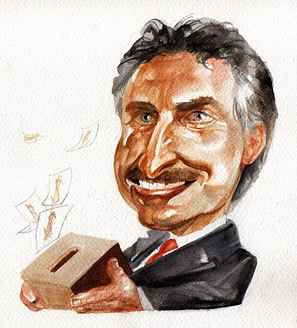
Mauricio Macri, who once described himself as 'hipermenemista' is a shady businessman who amassed, with his family, an ill-gotten-wealth-from military dictatorship to the present through spurious contracting with the state and not paying their own debts in the millions, which were added to the current debt externa.Parte of the family fortune was amassed through growing-Carlos Menem, thanks to some questionable privatizations of the country .

D uring the period 2010, the city of Buenos Aires had record revenues and prospects that will show him in 2011. However, underspending on infrastructure in the Federal Capital reaches high levels. The management macrista numbers speak for themselves. In the 2008 budget, for instance, the resources that got the city were 12,770 million pesos in every respect (ie, tax collection, finance management that got the Pro and domestic partnership). For 2011 there is a forecast of 25,260 million, most of which-about 18 billion pesos, from the collection of taxes.

But Macri prefers selling grandma's jewels to finance its policies. Although, as explained Raúl Sánchez, budget specialist who advises the legislature Juan Cabandié, "city revenue in 2011 will be almost ten times higher than those of 2002," posconvertibilidad year that revenues totaled 2,950 million pesos.


The local executive, who believes that property is "unnecessary for the management of this government," aims to create a trust to sell properties and thus achieve the financing of the works that must be addressed in the San Martin, at the time the official announcement, was $ 10 million. The funny thing is that a tour of properties with sale sign Pro evidence is used by the neighboring units. Namely:

- The estate of Rivadavia Avenue 5300, at the height of the Rivadavia Station subway line A, is a great shopping, with more than two dozen local-style La Salada, but in miniature, whose elimination would leave many families in the street.
- In the charming area of \u200b\u200bPalermo, on the 2400 Humboldt Street, just meters from Charcas, there a building whose apartment 5 ° belongs to the city of Buenos Aires. They operate a unit of the local judiciary. As appears from the bill, the hardware attached to this property, open and fully operational, also owned by the government and would be next to be sold, if approved by the Legislature.
- In Nicaragua, the 5500, next to a flashy modern building overlooks an old house that, according to the bill, it is also public property. As seen from Appendix macrista initiative, there are also works a unit of the local judiciary.
- On the Avenue Derqui to 3700, in the neighborhood of Parque Avellaneda, is a public square. Interestingly, one of the few green spaces in the city was not affected by the policy applied by the Pro lattice but which itself came the real estate cartel.
- Between the hustle and bustle of Avenida Córdoba vehicle to 2200-ie, at the height of the Faculty of Economic Sciences of the UBA-building is a Ceremonial and Protocol of the Government of the City, at whose head stands a large parking lot where lie different city government trucks. At least until now.
- In Saavedra, on Calle Núñez to 4200, and located opposite the railway works a garden with irrigation system. Are from 2002. If the tops Macri, be forgotten.
The list is long. Among the 18 remaining properties that are intended to sell, you can also find an area in the game Tigre, provincia de Buenos Aires, donde se encuentra la planta transmisora de Radio Ciudad, la emisora porteña. Ese terreno, de varias hectáreas y donde se ubican las tres antenas de transmisión, integra la lista de posibles desprendimientos del macrismo, con la advertencia de la necesidad de “relocalizar” las antenas, sin especificar cómo, dónde ni cuándo se llevaría ese proceso adelante.
FUENTE: REVISTA VEINTITRES

Wednesday, May 11, 2011

How Can I Find Bulk Jewelry Blanks

DOSSIER: MUGICA BY MUGICA

Carlos Mugica (1930-1974), cuyo nombre completo era Sergio Carlos Francisco Mugica Echagüe was an Argentine priest, linked to Movement of Priests for the Third World and popular struggles in Argentina in the 1960 and 1970. Most of his community work took place in Lavilla 31, which unofficially bears his name. He founded Christ the Worker Parish.


"I was born in the palace Ugarteche, I think they call it the palace of the Ducks and always lived in Barrio Norte, the school, my friends were all like me. my family had a deep Christian faith and was raised in an atmosphere of piety religious faith but it was a transcendentalist, very concerned about the salvation of the soul , not at all disturbed conformity felt toward everything around us. The other world, the world of the humble, not know him. I remember another, a neighborhood friend, Giménez, now a rancher, which was different, had a special way of talking to the poor: just gave, I remember him for that: because it was, it was more me. At that time was, however, an opportunity to touch things of people, (...) I'm a fan of racing fan, I liked to go to court . My father had plenty of silver were seven brothers. then gave me a weight per week, popular at that time was worth 50 cents ... I went to popular with Nico, the son of the cook. In court, during the outward journey and return, Nico and I shared the same things, plus we were the same, well ... well we were all equal: the joy was simple people and Nico and I were there. The world of bourgeoisie, however, is the world of differences is door service and entry of people, a food service personnel and a meal for employers. With football I grabbed some hoarseness barbaric, but also had problems of consciousness. I was very pious ... and in my prayers always asked God to win Racing on Sunday, my brother Alejandro was River, and he asked God to win River ... I thought 'now is not as God will fix, and well ... then will tie '. "
" He was a pious boy, and my way, happy. First, it was learned that was another kind of happiness ... after the other: another kind of piety. I remember one day talking to my confessor, Father Aguirre then today Bishop of San Isidro, I said, 'Father, today I am a happy guy: first, because there is a girl who brings me the point I think, secondly, because Fangio just be a world champion and third, because Racing is first. " That was all my problems at that time. I think my life had Fangio poured collapsed if the car or racing lost two-nil. The Aguirre father smiled and said, 'Look, I think that happiness depends deeper things ... 'then I found out. An extraordinary type Aguirre father was a man who was a man who lived for others. To him, after God and my mother I owe my priestly vocation. addition made me think for the first time that happiness is one things, but in the things of others. For all that, think which is one of the important people in my life. It was a decisive, the other will come much later ... when it crashed with a sign written in a dead sleep. My world was a world without homogeneous conflict, which, however, Ahmed's father had opened the first, very small gap, even my pity and my happiness were wearing their ; old skin. Until the nineteen years I had not crossed his mind I could be a priest. At twenty I entered the seminary:
was still in third year of law. Giving education in seminar, reading and meditating on the Bible, where indicated clear that God comes to all, but primarily God comes for the poor, I had been that the priest is called to a austere life, open to life of the poor. It was still seminarian and went to work alongside the parent Iriarte, now bishop of Reconquista, who was curate in the parish of Santa Rosa. The father Iriarte visited the people of the parish, not the expected, was looking for. was not just to go with the word of God was to collect ; the word of men. We tried to talk to people, to understand. was a crowded and poor people always have problems, there were course, to evangelize, to bring every security that all were children of God, but otherwise had to try to get everything else. A late 1954 and throughout the year 55, went to Father Iriarte visitar a la gente en sus casas. Una vez por semana, íbamos a un conventillo  que quedaba en la calle Catamarca y charlábamos con la gente. Yo preparaba  unos muchachos que luego tomaron la primera comunión; los domingos jugábamos al fútbol. Como en aquellas idas a la cancha con Nico,  era mi otra gran experiencia de ese mundo, el mundo de los humildes del  cual yo había vivido siempre distante. Pero esta vez, me iba a dar cuenta  was more inside, deep inside. " " They were the final days of the Peronist government. In my family, my father was large and had two brothers in Villa Devoto. E n the northern district bells began to fly and I was part of orgiastic joy of oligarchy by the fall of Perón. One night, I went to the tenement as usual. I had to go through a half-dark alley and suddenly, under the dim light of the single bulb, I saw written in chalk and lyrics well large : 'Without Perón, no country or God. Down the crows' . The people of tenement knew me well, I was quite intimate with her during all that time (after I kept going, most of the year 56). However, for me writing what I saw was a shock: that night was later in my life. At home I found the people crushed with great sadness . I was a member of the Church and they ascribed to the Church part of the responsibility of the fall of Perón. I felt pretty uncomfortable, but did not say anything. When I went to the inhaled street sadness in the neighborhood. Humble people mourned by the fall of Perón. " " And if people humble stable duel, then I was misplaced: I was on the sidewalk in front. I remembered Mary. had occurred long time I had forgotten. One summer he went with my brother in the rental, to the field. Since then I wrote my parents. In farewell letter had 'Greetings to the maids'. When returned outside Mary told me: 'Carlos, we are not servants: are human beings' . It was the same thing as the sign of the alley. If Mary had written on one wall of my house '... we loved
human ', well ... it had been deleted or had perhaps missed. Yes, I was on the sidewalk in front. Now poor people mourned and should think about the meaning of that sadness. When he came home to my world at that time was savoring the victory, I felt something of that world, and, had collapsed. But I liked it. "


Source: Journal Questionnaire No. 1, May 1973